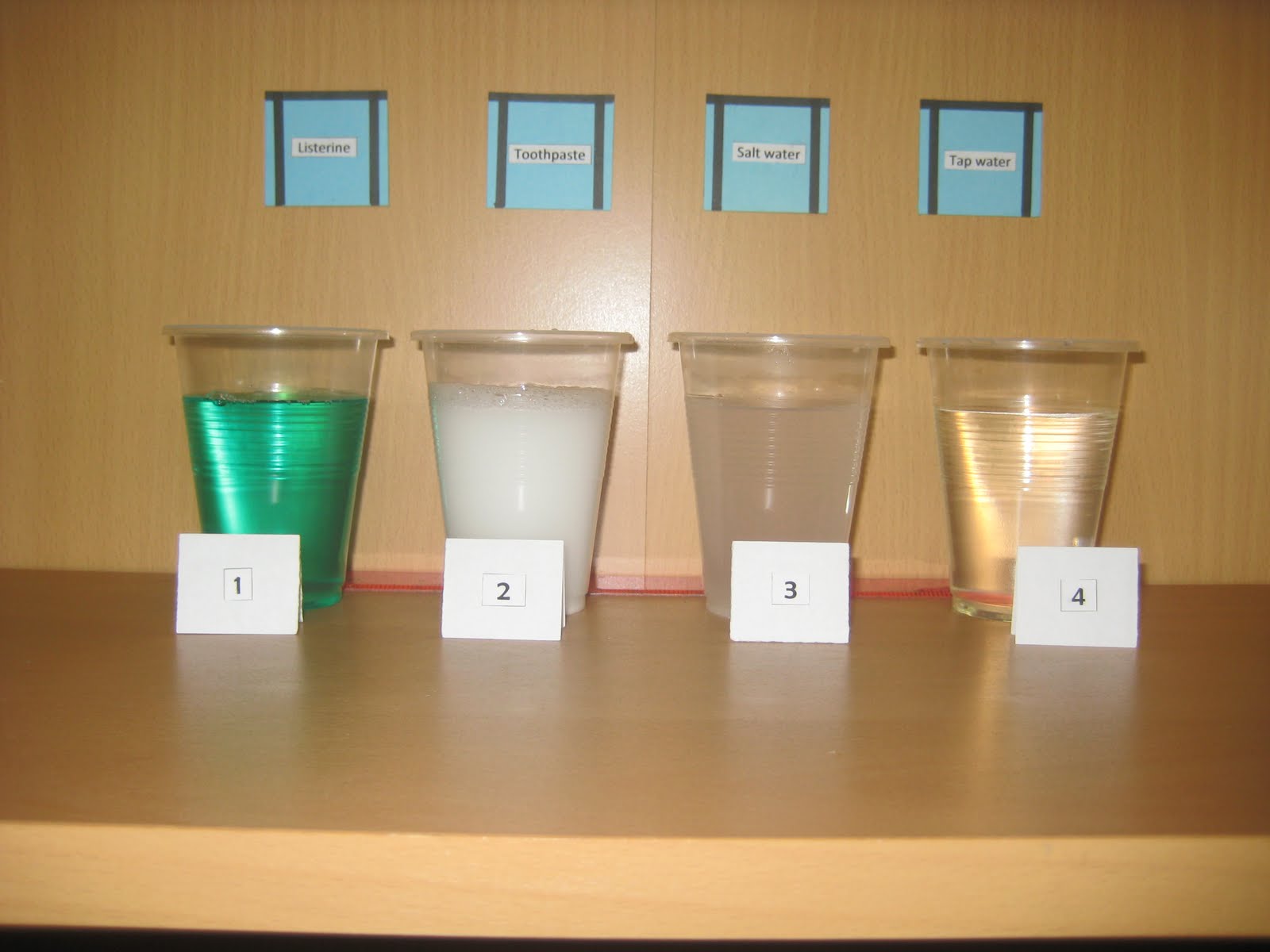
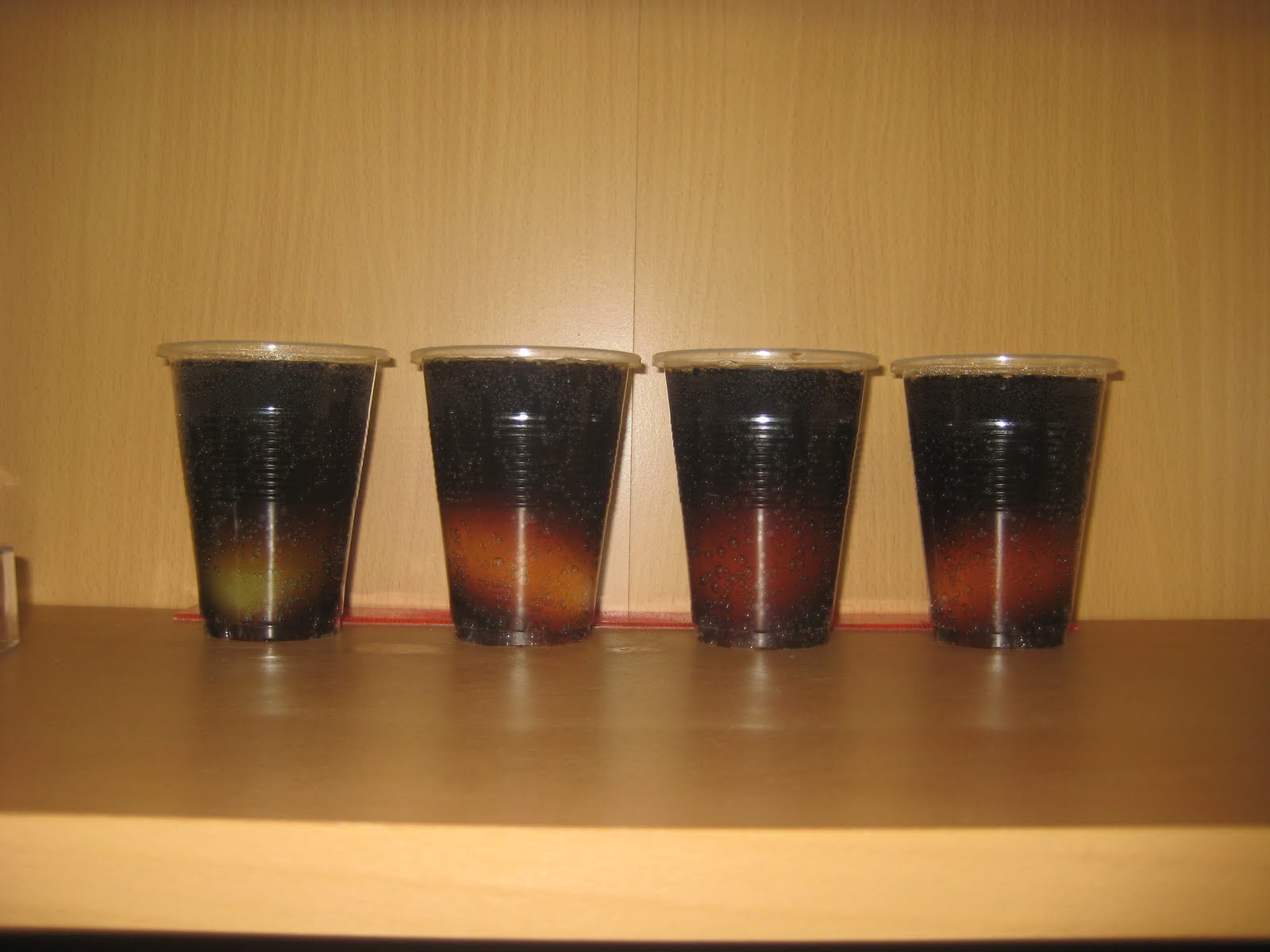
and just in case you wanted to have a look at all the pictures...
these were some of the photos i took during the experiment: TRIAL 1:
Wednesday, May 5, 2010
more information:
i was looking through the ingredients of the listerine and toothpaste products and found that overall, my solvents (besides the control- water) contains sodium:
the listerine i'm using contains sodium benzoates the toothpaste i'm using contains sodium monofluorophosphate salt water is otherwise known as sodium chloride solution
but does that mean that sodium is what protects the teeth? i did a little research and found that sodium itself, generally, isn't used for anything because it is very reactive. but when combined with other substances, it may be used for a variety of things:
sodium benzoate- commercial food preservative sodium fluoride- used to promote healthy teeth sodium chloride - table salt
which means it isn't the sodium element itself, but the sodium element within a sodium compound/mixture that is related to this experiment
why is this experiment useful? we all know that there are some people who loves to brush their teeth, some who hate it, and others who are.. in between.
keeping your teeth healthy and clean: the experiment allows us to determine whether someone (who is very lazy and doesn't take great care in their teeth) will have the same or worse teeth conditions than someone who is serious about keeping their teeth clean and healthy.
it will determine whether the tooth enamel really is protected when using.. 'protection'
in this experiment, the teeth is represented by the egg (shells) and the plague (that we develop on our teeth everyday due to eating food) is represented by the different types of soda drinks.
some reasons why you should keep your teeth clean and healthy: - you'll look prettier - you won't get gum disease (unless you smoke) - you won't get cavities (holes in teeth) - your teeth won't fall out - your teeth won't rot
handy hints on the best ways to clean your teeth: - brush at least twice a day - brush for a period of more than 2 minutes - use short strokes up and down back and forth - remember to floss
just one of the science holiday homework we had to do:
so this is the climate graph for 'Weather for Sydney' (click for a larger image)
the result of an hour of excel and cutting and pasting on paint ..and saving
Saturday, April 10, 2010
METHOD: aim:
to determine what type of solution best protects egg shells from acids
hypothesis: the solution that contains the most amount of sodium, will protect egg shells from acids, the best
risk assessment: method: 1. collect a dozen eggs (uncooked), 140mls of coke, lemonade and fanta, containers (8) and three lots of 140mls of Listerine, toothpaste and water in ratio 1:13 , salted water in ratio 2:5 and tap water
2. take a picture of the first 4 eggs(for colour reference- at the end)- note remember which egg is which
3. fill up 4 containers of one 'lot' of solvents (Listerine, toothpaste compound, salt water and tap water) 4. soak the eggs (4) in the solvents for 3 days
5. pick up the eggs slowly, placing them on a stand to dry. note: do not wipe them dry
6. place the eggs in separate containers of coke and leave aside for 2 day
7. pick up the eggs and, with a towel,lightly dry them, then scrub clean.
8. observe the eggs- what is the colour difference compared to the matching photo taken in step 2
9. record the results in a table
10. repeat steps 2-9 for the rest of the eggs,this time placing them in lemonade and fanta instead of coke
results:
conclusion: --
note: ~ i think my aim and hypothesis makes sense...
might have to do a bit more research
~ i couldn't really assess more risks because my experiment isn't dangerous. so i just have one :)
~ because i have written a method in blog 5 without a clear idea as to the amount of liquids used or the amount of days the eggs can be left in the containers, i have changed a few things from that method to make the one above- the amounts of liquids (volume), ratios and days have been changed to conduct this experiment more easily and to suit the containers and how much (grams/ milligrams) of the materials i have bought ~ with my results, i found a colour wheel/chart thing that shows a variety of colours and different shades in that form. so i will be using that to differentiate the colour before and after the experiment. whether the colour change is lighter or darker depends on whether the number on the colour wheel/chart is greater than or less than the previous one.
~ the conclusion (obviously) has not been written up yet because the experiment has not yet been conducted.
...hope that all made sense
now that that's all done, i shall start my experiment
if any problems shall arise, I'll be sure to let you know
wish me luck
..i hope this all goes well and that i don't make any mistakes :)


 method:
 conclusion: